Thomas J Parlette
A Three Dimensional Church”
Haggai 1:15b-2:9
11/10/19
When someone mentions 3D printing, what probably comes to mind is a desktop-sized printer from a high end catalog like Hammacher Schlemmer, The Sharper Image or Brookstone, that can produce small three dimensional objects. Some of these objects are very useful. 3D printers can turn out anything from auto parts to acoustic guitars to camera lenses, prosthetic limbs and much more.
But the technology is now being applied on a far larger scale. 3D printing machines the size of a house can print prefabricated parts for full-sized houses – or even complete small houses – and can do so repeatedly and rapidly, with each one an exact replica of the preceding one. Thus, 3D printing is now an industrial production technology.
The headline for one article about this large scale printing reads, “This giant 3D printer can build 10 prefab homes in under 24 hours!” Granted, they aren’t huge homes, but 10 in 24 hours is remarkable. Just think how that could help provide shelters following a natural disaster, to say nothing about alleviating our homeless problem and maybe reducing the cost of everyday house construction.
Who knows, 3D printing might even find its way into the church world too. According to Danae Dougherty, managing principal with Visioneering Studios Inc in Irvine, California, 3D printing of church buildings is a little way off yet. He says, 3D is still pretty experimental for architecture and construction…the actual time test for this technology hasn’t been met yet.”(1)
So the first churches produced using 3D printers will probably be plain and simple – humble dwellings for the Divine.
The Jews who had returned to Jerusalem after their exile in Babylon may have felt that way about what was left of their once great Temple. All they had left was a very humble – some might say run down – dwelling place for God.
This text from Haggai, very precisely dated to October 21st, 520 BC, is from a series of addresses or perhaps sermons delivered to Zerubabbel, the Governor of Judah and the High Priest Joshua. Here we find speaking to the people of Judah on God’s behalf. The listeners include the remnant living before the Temple’s destruction and those too young to have experienced the horror. All have returned from exile. Cyrus, the emperor of Persia, has permitted the Jews to come home and rebuild the Temple, but the rebuilding effort has come to a stand still. The Jew’s commitment to temple reconstruction has cooled. The people have lost their priorities and have focused more on their own homes and personal security than on establishing the center of their faith community.
This passage amounts to a pep talk, sort of a halftime speech to rally the team to get going on their re-building project. Yes, it’s a challenge, but Haggai reminds the people that God promises that there will be more to come: “The latter splendor of this house shall be greater than the former, says the Lord of Hosts; and in this place I will give prosperity, says the Lord of Hosts.” The Temple would eventually be 3 dimensional in the best sense of that term, the Lord said.
Granted, the church of the post-Pentecost era is not a building, per say, that we can print out of a 3D printer and put together. The church is ultimately people. There are three dimensions that apply to us nonetheless – height, depth and breadth.
Of the three, in recent years, churches have concentrated on breadth. We have tried to make our churches welcoming of a greater range of people than historically had been true of the church. Individual churches have done that by adding contemporary services, making bulletins more user friendly, preaching lots of “love your neighbor” sermons, putting a coffee shop in somewhere around the church, creating small groups that might be of interest to a wide range of people and by eliminating barriers of race, sexual orientation along with physical barriers as we have tried to increase our accessibility.
The church has worked to become more open. It has elevated inclusivity and diversity top to the level of virtues, and that’s a good thing. But in some cases, however, the focus on breadth has been at the expense of height and depth.
This is a problem because height is the starting point for what makes us “the church”. Height can represent for us the relationship we have with that which is higher than ourselves – our Creator and Lord. But we can get so involved in horizontal relationships with each other and our community that we neglect to cultivate the vertical relationship, our relationship with God.
For instance, twelve step programs like AA challenge the church not to forget height when thinking about our religious life. In these programs, the first step is to acknowledge that you are powerless to resist our addiction by your own power. The second step is to turn control of one’s life over to a higher power. Sounds very familiar. Twelve step programs recognize that the people who turn to them for help have gotten the dimensions of their lives out of balance and have neglected the higher connection.
Centuries ago, Saint Augustine wrote, “Thou hast made us for thyself alone, O God, and our hearts are restless until they find their rest in thee.” Augustine who pointing us to the dimension of height in our life of faith.
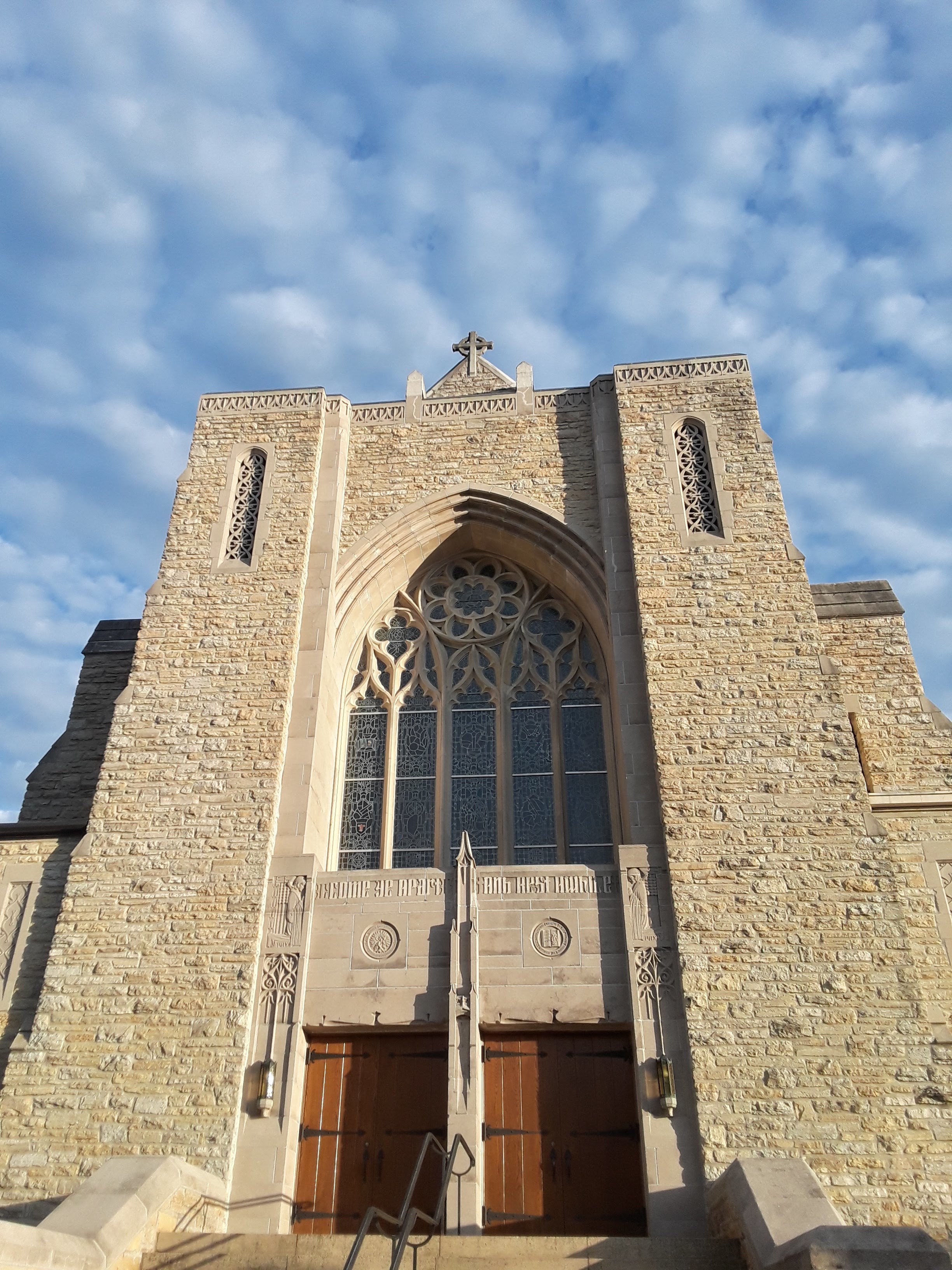
Church architecture is designed to do this as well. Most classically designed churches are raised above the level ground, so you have to walk up steps to get in – like our original doors are. Then when you enter the church, you are struck with grand vaulted ceiling and long, ornate stained glass windows, that draw you eye, and hopefully your spirit, up towards God. Church architecture as meant to point to God, focus our attention upward and at the same time remind us that we are not bigger, or higher, than God.
Donna Schaper, a prominent pastor in the New York area, once told a story about sacred space to Bearings Online:
“Sacred space, she said, “is a temple for the spirit or flesh for the spirit. In more than 40 years as a minister I’ve had one fight after another about sacred space. They are always budget fights – Should we feed the poor of fix the roof. It’s always a hard choice. I argue that it’s not really an either/or kind of thing, but a nested event – the roof and the walls, the whole building houses the spirit of the people which then goes on to give them energy for feeding the poor. We want to do both with spiritual vigor.”
“I remember a quarrel I had with one of my wealthier parishioners in Riverhead, New York. She wanted to put a carillon in the steeple. I wanted her to fund the homeless shelter in the building, which housed 150-plus people a night. She refused, and the carillon went in. It cost 10,000 dollars. The first night it played at 5:00 pm. At 5:15, I ran into my neighbor who was the executive director of the Methadone clinic next door. She had tears in her eyes. She said, “The music is so beautiful. It pierces the sky! It is going to help me get through the day.”
“Houses of worship help people of all kinds get through their day. Sometimes we do that by feeding them spiritually. Sometimes we do that by feeding them physically. There is very little reason not to do both.”
“I was wrong in my approach to her gift. I was doing the “spirit good, money bad” thing that so many social activists have done for so long. We couldn’t see the centrality of spiritual hospitality to our ministries. We wanted “doing good” to be more important than it was. If people are not filled spiritually, they won’t be able to do the good that they want to do.”(2)
Our sacred space, the music we make, the words we preach, all contribute to our dimension of height – drawing our attention to the One greater than ourselves.
That brings us to our third dimension – Depth, which can represent discipleship over the long haul. Most of us can take one of Jesus’ teachings from the Sermon on the Mount and do it pretty well for a little while. Being a peacemaker for a day isn’t too hard – but being a peacemaker year after year is another thing altogether. Turning the other cheek occasionally is doable – but for many, making cheek-turning a way of life requires a great commitment. Even praying for those who are a pain in the neck sometimes is possible – but being kind and charitable toward difficult people on a permanent basis requires significant energy and spiritual depth.
The prophet Habakkuk had something to say about this. He says “The righteous live by their faith”, or in some translations, “their faithfulness.”
Remaining faithful is not the most exciting posture in today’s world, which favors instant gratification. Pastor and author Eugene Peterson writes: “One aspect of the world that I have been able to identify as harmful to Christians is the assumption that anything worthwhile can be acquired at once. We assume that of something can be done at all, it can be done quickly and efficiently… There is a great market for religious experience in the world; there is little enthusiasm for the patient acquisition of virtue, little inclination to sign up for a long apprenticeship in what earlier generations of Christians called “holiness.”
To give us a way to think about what perseverance in the Christian life is, Peterson borrows a phrase from the philosopher Friedrich Nietzsche and describes the Christian life as “a long obedience in the same direction.”(3) Paul put it a different way when he said “Let us not get tired of doing good, because in time we’ll have a harvest if we don’t give up.”
Building a dimension of depth in our spiritual life is all about remaining faithful – a long obedience in the same direction.
On Easter Sunday, 2014, after 170 years on Mount Hope Avenue in Rochester, New York – South Presbyterian Church voted to sell it’s historic building. Voting on Easter was no accident – they liked the symbolism of resurrection. “To commemorate the sale of the property, we held a combined service in August,” said the Rev. Deborah Fae Swift, South Presbyterian’s pastor. “We presented the owners, a Free Methodist congregation with the keys, and the trowel that was used to lay the buildings cornerstone in 1894, and used again when we expanded the church in the 1920’s.”
“None of us regrets selling,” she said. “Sometimes people from other churches will approach one of us with an “I’m so sorry for you” tone of voice – which catches all of our members of guard. Our evangelism coordinator has the best response. She likes to say, “Don’t be sorry. We’re not. It’s the best thing that’s ever happened to us. We have energy and we are unencumbered with repairs and upkeep…”
The 40 or so members of South Presbyterian touched nearly 500 lives last year in Rochester through 16 active, member-led Acts of Faith community groups(4)
They don’t have a building anymore – but they’re not tired of doing good. They are remaining faithful, and continue to pay attention to the dimension of depth in their spiritual lives.
The common thread in all of this is that though life may be hard, and there may be troubles, and evildoers will sometimes come out on top – steady faithfulness to God, enduring trust in God’s assurance, persevering reliance on God’s strength, a long obedience in the Lord’s direction, holy living every day – whatever we choose to call it – is the way to go.
Depth is the church’s ongoing faithfulness. That depth depends on the church’s height – its vertical connection to Almighty God – and it pushes us to be a people of breadth as well.
If we’re going to print a 3 dimensional church, let it be a church with breadth, height and depth.
May God be praised. Amen.
1. Homileticsonline, retrieved 10/24/19
2. Ibid.
3. Ibid.
4. Ibid.